
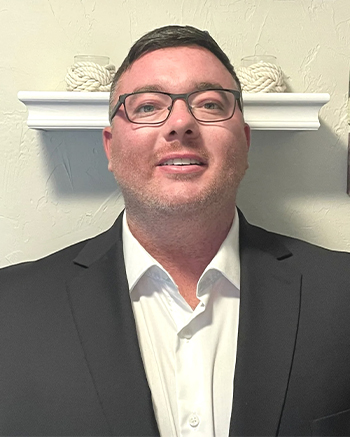
James M. Kennedy APRN, PMHNP-BC, ADHD-CCSP
Founder and CEO. A prescriber who specialized in ADHD rather than a generalist who sees it sometimes. Adults with ADHD, depression and anxiety. Human first, evidence always.
Duxbury, Boston Back Bay, and telehealth across Massachusetts and New Hampshire

Built to Catch the Signal Early
You are probably here because something is not working the way it should. Your focus, your mood, your energy, or a medication regimen that has grown over years without anyone stepping back to ask whether it still makes sense. You have likely already been told to try harder, sleep more, or give it time. What you have not been given is a clear answer, or a clear explanation of what is actually going on. That is the job I built this practice to do, and the way I do it starts with the person in front of me rather than the diagnosis on the chart.
From the inpatient unit to a different model
I came to outpatient psychiatry from an inpatient-only world: a registered nurse at McLean Hospital, a charge nurse at Newton-Wellesley Hospital, and later an attending nurse practitioner on an inpatient psychiatric unit. In acute settings I treated the highest-acuity patients in psychiatry, and I saw the same pattern repeat: a patient arrives in crisis because nobody caught the signal six weeks earlier. The care was reactive. It responded to collapse instead of preventing it. When I founded Modern Mentality in 2022, I started from a blank canvas with one requirement, that the practice would work the other way around. Outpatient ADHD care built on that foundation means nothing walks through the door that I have not seen a harder version of.
We diagnose before we treat
Most ADHD care starts with a fifteen-minute conversation and a prescription. Ours starts with a full diagnostic suite: a structured clinical evaluation, collateral history, the CAARS-2 for adults, FDA-cleared TOVA continuous performance testing, and Creyos cognitive testing at baseline. You leave knowing what you have, what you do not, and what we are actually treating. That includes catching the things that masquerade as ADHD, like anxiety, depression and sleep, and the things that ride along with it, like autism. For depression and anxiety the same principle holds: validated measures at intake and before every follow-up, so the plan is tracking a number rather than an impression. When medication selection is uncertain, GeneSight pharmacogenetic testing informs prescribing instead of a sequence of trials.
We measure everything, and keep measuring
Creyos retesting about every twelve weeks, across the exact domains ADHD hits: attention, working memory, processing speed, inhibition, flexibility, planning. That means medication response is a number, not a feeling, and progress is a trendline, not a guess. You see objective proof the plan is working, and when it is not, we see that too and change course that week rather than at the next scheduled visit. None of this is complicated. It is simply done every time, by every clinician here, and that discipline is the whole difference. Outcomes follow from process. Build the right process and hold to it, and the outcomes take care of themselves.
Illustrative, not patient data. This is the shape a quarter is supposed to take: validated scores at every visit, Creyos retesting about every twelve weeks, and a course change the week a line turns the wrong way.
Medication as leverage, skills as the treatment
The lens I work from: ADHD is a disorder of doing what you know, not of knowing what to do. Medication raises the dopamine floor so the prefrontal cortex can hold a plan online long enough to run it. It does not install skills. It makes the skills you build actually hold. So I titrate to function rather than to a dose, match coverage to the real demand windows in your day (the work block, the 4 PM collapse, the evening you need back), and name the trade-offs honestly. The other half is a structured executive-function curriculum built on scaffolding: external supports first, faded deliberately as competence grows. Working memory workarounds, planning systems, the daily architecture that turns capacity into performance. I treat that as a partnership with a shared set of goals, and I expect you to bring your own judgment about what is working in your actual life. Medication buys access. Skill-building creates the durable change. A plan you cannot run on a Tuesday afternoon is not a plan.
The people I see
I see adults only, across the lifespan: the graduate student who can only concentrate after midnight, the executive who has built elaborate systems to work around a focus problem, the parent running a complicated household on willpower, the retiree who was never evaluated and has wondered for forty years. Most of them are capable and accomplished and have been quietly compensating for something for a long time. Whether they come to me in Duxbury or on Beacon Street, they tend to want the same things: a straight answer, a plan they can actually run inside a working week, and a clinician who treats their time as the scarce resource it is.
What I offer in return is candor. I will tell you what the evidence supports and what it does not. Where medication helps and where it is oversold. What a number means and what it cannot tell you. In a field full of ten-minute med checks and miracle promises, calibrated honesty is the differentiator, and it is the thing my patients say they came for.
The whole person, with the strongest tools in psychiatry
I brought NeuroStar TMS into the practice because I was tired of watching people with real treatment-resistant depression get offered a fourth antidepressant and a shrug. When the mood floor has collapsed, nothing else holds, so we restore it first. TMS is FDA-cleared and non-systemic, and for the right patient it changes the trajectory in weeks. What makes it work in our hands is the same thing that makes everything else work: careful selection, a medication history documented well enough that authorization is not a fight, symptom scores through the entire course, and integration with therapy and medication management rather than a procedure that stands alone. Therapy is on staff. Anxiety, mood and sleep are managed alongside the ADHD rather than stacked on top of it. One roof, one treatment plan, one clinician accountable for the whole picture.
Teaching and research
I take students because teaching is the best quality control I know. I have taught psychiatric nurse practitioner students since 2020: as a term lecturer and clinical instructor at the MGH Institute of Health Professions, where I taught biobehavioral principles and theories, as a visiting clinical instructor at Regis College, and now in my own practice. Modern Mentality is a clinical training site for Boston College’s Doctor of Nursing Practice program, and I precept and instruct PMHNP students directly. A student watching you work forces you to defend every diagnostic call and every prescribing decision out loud, and if you cannot defend it, you should not be doing it. I ask them to critique me, not flatter me. The standard I hold in the room is the one I am training the next generation of prescribers to meet. The practice is also partnering on an active three-semester DNP research project to validate our ADHD assessment protocol and refine how we match patients to the interventions most likely to work for them.
The business of good care
Modern Mentality was not inherited. It was designed from a blank canvas around one conviction: that ADHD care should be measured, honest, and whole-person. The MBA at Boston College’s Carroll School of Management is the same instinct applied to the business. Great care fails when the organization around it is sloppy: clinicians drowning in administrative work, billing chaos, no capital for the equipment that moves outcomes. A practice that runs well clinically and operationally is the one that is still here for you in five years. It is also why premium care here does not require a concierge price tag: we take commercial insurance, and we built the model to work inside it.
Duxbury and Back Bay
I see patients at our Duxbury office, at 264 Beacon Street in Back Bay, and by telehealth across Massachusetts and New Hampshire. The South Shore is home. Outside the clinic I am on the water when the weather allows, at the Garden as a Bruins season-ticket holder when the schedule allows, and in the kitchen working on a paella when neither does.
James M. KennedyAPRN, PMHNP-BC, ADHD-CCSP. Founder and CEO, Modern Mentality
Biology, skills, mood, data, and the life around them, treated as one problem by one team, with proof that it is working every quarter.
James M. Kennedy, APRN, PMHNP-BC, ADHD-CCSP
What James Treats
Choose one to read how he approaches it.
ADHD
The evaluation is the product. A structured clinical evaluation, collateral history, the CAARS-2, TOVA attention testing and Creyos cognitive testing come before any diagnosis, so what follows rests on evidence rather than a questionnaire, and so anxiety, depression, sleep or autism are not mistaken for ADHD or missed beside it. Then Creyos retesting about every twelve weeks turns medication response into a number and progress into a trendline. From there the work is as much skills as medication: a structured executive-function curriculum, scaffolded and then faded as competence grows. James sees adults who were never assessed, adults who were assessed badly, and adults who have been medicated for years without anyone checking whether it is still the right call.
Depression & Treatment-Resistant Depression
Scores are tracked at every visit, and the plan changes when the scores do. When two or three medications have not worked, James does not reach for a fourth by default. For the depression that flattens every other intervention, NeuroStar TMS restores the mood floor so the rest of the plan can hold: FDA-cleared, non-systemic, delivered in the Duxbury office, and integrated with therapy and medication management rather than offered as a last resort.
Anxiety
Generalized anxiety, panic, and the high-functioning kind that never shows up at work but runs every night at eleven. Precise pharmacology where it helps, paired with therapy from the clinicians down the hall, and a measured check at each visit so improvement is something you can see, not something you hope for.
Medication Decisions
Second opinions on a regimen that has grown over years. Starting medication when nothing has been tried. Simplifying when too much has. When selection is unclear, GeneSight pharmacogenetic testing informs prescribing so the first choice is more likely to be the right one.
Who James Works Best With
Fit matters. Here is an honest read on both sides of it.
James is probably a good fit if you
- Want objective testing before anyone gives you a diagnosis
- Have tried several medications and want a plan, not another trial
- Want your prescriber and your therapist in the same practice, talking to each other
- Have a working calendar and need telehealth that fits inside it
- Want a clinician who will tell you what the data shows and what he would do about it
- Want to understand your own ADHD and build the skills to manage it, not just fill a prescription
- Suspect something else is travelling with the ADHD (anxiety, sleep, mood) and want it sorted out rather than stacked on
- Are weighing TMS and want it weighed honestly, as one option inside a full plan rather than a procedure sold on its own
James may not be the right match if you
- Want therapy only, without a prescriber. Sarah Carey, Maria Martinez Calderon and Joe Giallombardo are the people to ask for
- Want a prescription without an evaluation. Every patient is evaluated first, without exception
- Are in acute crisis and need stabilization rather than outpatient care
Not sure? Our intake team will match you with the right clinician on the team, even if it is not James.
How the Practice Works
The Evaluation Comes First, Then the Explanation
No prescription without a real assessment. For ADHD that is a standardized protocol with objective testing; for everything else it is a structured interview and validated measures. Then you get the results explained in plain language, because a diagnosis you understand is one you can do something with.
Measurement as the Early Warning System
PHQ-9, GAD-7, the CAARS-2 and the C-SSRS at every visit, and Creyos retesting about every twelve weeks across attention, working memory, processing speed, inhibition, flexibility and planning. A score moving the wrong way is acted on that week rather than at the next scheduled visit.
TMS as a Real Option
For treatment-resistant depression, NeuroStar TMS is offered when the evidence supports it, not as a last resort: careful selection, a properly documented medication history, symptom scores through the whole course, and integration with the rest of the plan.
Teaching as Quality Control
A PMHNP student watching you work forces you to defend every diagnostic call and prescribing decision out loud. James has taught PMHNP students since 2020 at the MGH Institute of Health Professions and Regis College, precepts Boston College DNP students in the practice, asks them to critique him rather than flatter him, and holds himself to the standard he is training them to meet.
From First Contact to a Plan
Most new patients are seen within two weeks.
Request an intake
Online, in about two minutes, or by phone at (781) 803-7757. Tell us what you are looking for; you do not need to have it figured out.
We verify your benefits
Our team reaches out within two business days and checks your insurance before your first visit, so there are no surprises afterward.
The evaluation
Your first appointment is a structured assessment, not a quick prescription visit. For ADHD, objective testing is scheduled as part of the package.
A plan you helped write
You leave with a plan, a timeline, the measures we will track, and for ADHD the first skills to work on. Every follow-up starts with the score and with what actually happened in your week.
Clinical Background
Two Offices and a Screen
Same evaluation, same measures, same clinician, wherever you are seen.

Start With a Real Evaluation
James is accepting new patients in Duxbury, Boston Back Bay and by telehealth across Massachusetts and New Hampshire. Commercial insurance accepted; premium care here does not require a concierge price tag. Booking online takes about two minutes, benefits are verified before your first visit, and most new patients are seen within two weeks.